Tell us about the job
Takes about a minute. No obligation.
A contractor quoting a boiler installation in Stark County has to treat sizing and fit-up as load questions, not box-selection questions. Homes in Stark County, ND run heat about ten months a year, from September through June. The burner and ignition system cycle through nearly the entire calendar year, and wear on those parts is proportional to how hard the equipment is asked to work each cycle. A boiler that is undersized for the house runs longer burner cycles to hit setpoint, which shortens the life of the heat exchanger and the ignition assembly faster than a correctly sized unit would. The contractor's load calculation here is the document that determines which of those outcomes the homeowner gets.
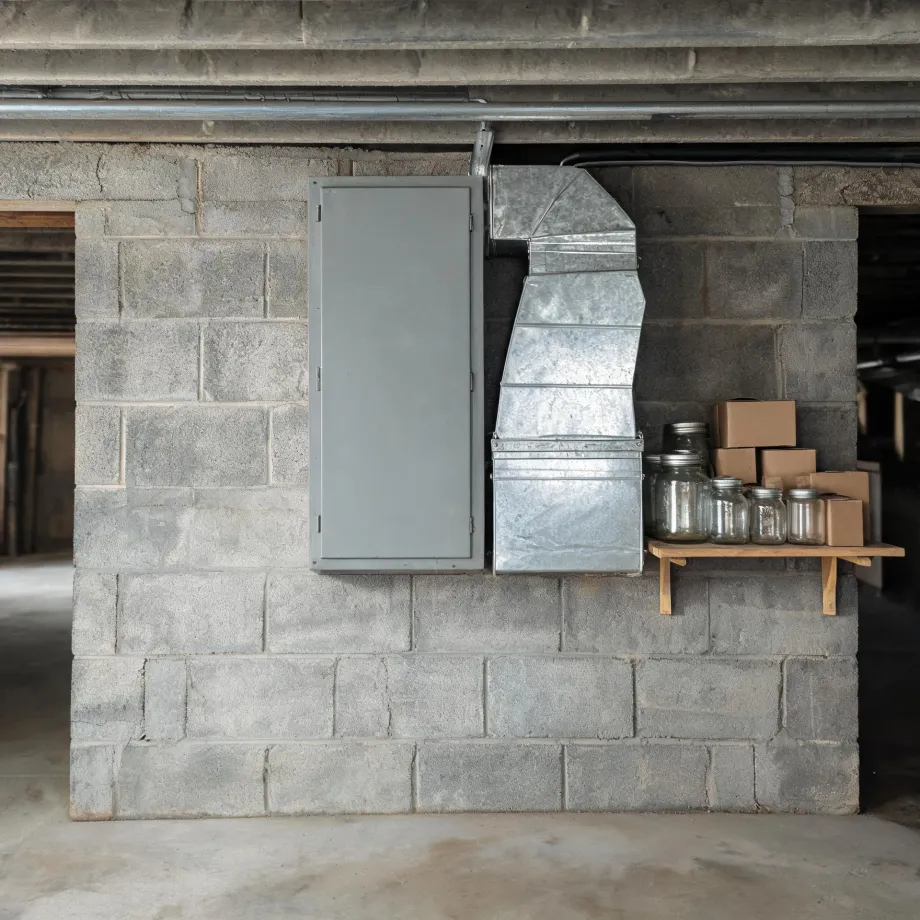
Existing ductwork is what a boiler installation in Stark County actually pivots on. Half the homes in Stark County, North Dakota were built in 1986 or earlier (2020-2024 ACS 5-year). Houses built across that span were ducted for whatever equipment the builder specified at the time, and that configuration is still in the walls. A new boiler has to move heat through what is already there. A contractor checking whether the existing runs and passage sizes suit the new unit is doing the work that decides whether the installation goes cleanly or requires modification before the equipment is ever set.
What Gets Installed With a New Boiler
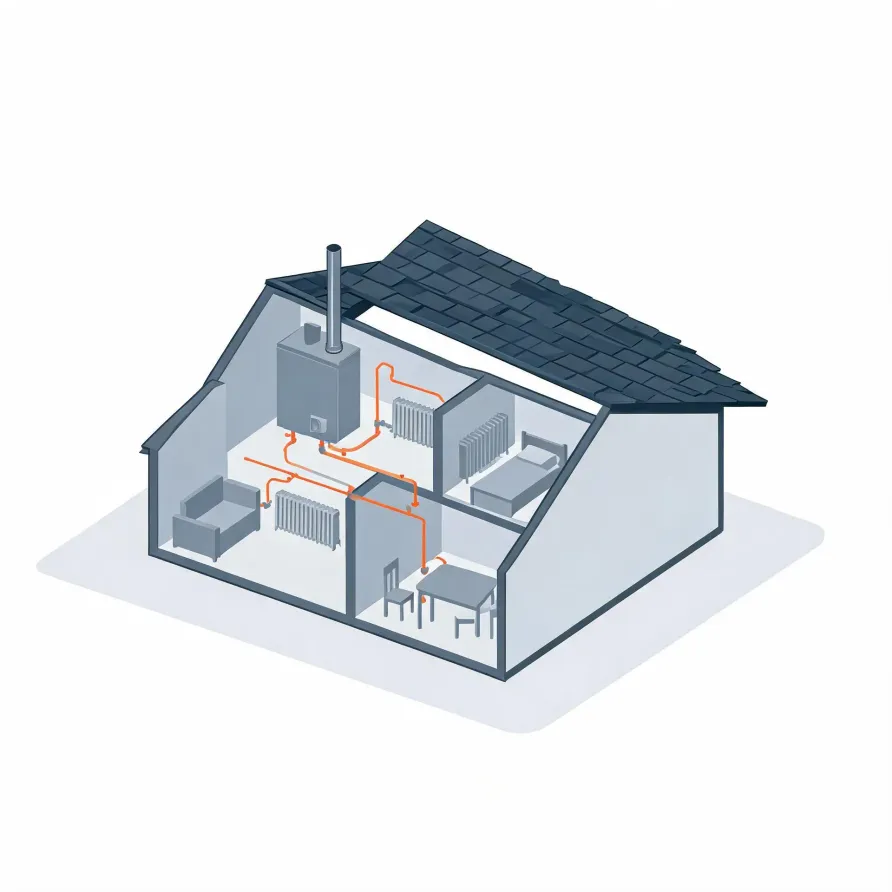
The boiler itself sits in a mechanical room, utility space, or basement, and is the unit that heats water and sends it through the system. Alongside it, the expansion tank mounts nearby to absorb pressure changes in the water as it heats and cools. The circulator pump, also near the boiler, pushes the heated water through the pipes.
From the boiler, supply and return pipes run through the house to the heat emitters, which are either baseboard radiators along the walls or radiant tubing beneath the floor. A thermostat, mounted on an interior wall, is what signals the boiler to fire. The pressure and temperature controls that mount directly on the boiler round out what a contractor puts in place.
The drawing shows a typical layout, and a licensed contractor determines exactly what applies to your home.
Find a contractor in Stark CountyStark County, by the numbers
185 severe weather events were recorded in Stark County, North Dakota between 2015 and 2024.
NOAA National Centers for Environmental Information, Storm Events Database, bulk CSV export, events 2015-01-01 through 2024-12-31.Half the homes in Stark County, North Dakota were built in 1986 or earlier (2020-2024 ACS 5-year).
U.S. Census Bureau, 2020-2024 American Community Survey 5-Year EstimatesStark County, North Dakota holds 15,514 housing units (2020-2024 ACS 5-year).
U.S. Census Bureau, 2020-2024 American Community Survey 5-Year EstimatesOwners occupy 66.8% of the occupied homes in Stark County, North Dakota (2020-2024 ACS 5-year).
U.S. Census Bureau, 2020-2024 American Community Survey 5-Year EstimatesBoiler Installation Rules for Stark County, North Dakota1 codes, standards, and statutes
Licensing Rules for Stark County, North Dakota
North Dakota requires a contractor licence once the cost, value or price of a job exceeds four thousand dollars, and an unlicensed contractor may not bring a claim or a lawsuit in a North Dakota court over the work.
Severe Weather Events in Stark County
Stark County's weather puts real demands on heating equipment, and those demands are local, not national averages. A boiler sized and installed for this climate handles the load differently than one dropped in from a milder place.
185 severe weather events, 2015–2024. Source: NOAA National Centers for Environmental Information, Storm Events Database.